
Back to insights

Decima’s approach to AI

Our founders have worked with AI for over a decade. We use it every day – and we don’t trust it to do everything unsupervised. Here’s why, and how we keep a human in control.

July 28, 2026
Approach to AI

Our founders started working with AI over a decade ago, long before ChatGPT, Claude and Gemini became household names. We’ve watched it move from a research discipline to something that’s rapidly changing how businesses operate. We use AI every day, helping us to code, answer business questions or even help us decide where to go for lunch!

But we don’t trust it to do everything. And we think you shouldn’t either.

Why We Don’t Trust AI For Everything

The tools we’ve come to know as “AI” that write copy, answer questions, or make suggestions (the technical name is a large language model) don’t actually know anything. They work by predicting the most likely next word in a sentence, over and over, based on patterns learned from enormous amounts of text.

While this is an incredibly useful trick, it’s also the reason these tools will always, statistically, get things wrong sometimes. They’re not built to care whether an answer is true, only whether it sounds like something true would sound. Most of the time those are the same thing. Sometimes they’re not, and they’re not designed to tell you when they’re not.

This isn’t necessarily a danger when you’re using ChatGPT for a restaurant recommendation, but some businesses build “agentic workflow” chains where one AI’s output automatically becomes the next AI’s input, with no person checking the join. Think of it like a photocopy of a photocopy of a photocopy, except each copy is also occasionally confident and wrong. Each extra link in that chain doesn’t just add a small amount of extra risk. The chance of something going off the rails compounds fast, because every step can introduce a new mistake on top of the last one.

Human In Control

At Decima, AI is a tool we point at specific, well-defined jobs, inside guardrails we’ve built and tested, with a person always checking the output before it goes anywhere near your customers or your budget. We use it to do things faster and cheaper, not to do things unsupervised.

We also use more than one type of AI, because different jobs need different tools:

  • Traditional machine learning: pattern-finding models trained to do one narrow job well, like predicting which customers are likely to convert. These are measurable, testable, and consistent, because they’re built for a specific question with a specific right answer.
  • Generative AI: the newer, more flexible tools that can draft, summarise, and suggest. Brilliant for speeding up ideas and first drafts. Never left to make final decisions with your money on the line.

The result is straightforward: you get the speed AI offers, without gambling your marketing spend on a system without human supervision. Every experiment we run still sits inside the same Decisive Marketing approach, tested, measured, and refined by people who are accountable for the outcome.

How these models actually work

Large language models are, architecturally, next-word prediction engines built on an architecture called a transformer. During training, the model is shown enormous volumes of text and adjusts billions of internal parameters to maximise the statistical probability that a given word follows the words before it. There’s no internal model of “truth” being checked against, no fact database being queried, and no reasoning process in the way a person would recognise it. There’s a probability distribution over possible next words, and the model samples from it.

This is precisely why hallucination (the industry term for a model confidently producing something false) isn’t a rare glitch to be patched out. It’s an expected output of the underlying method: the model will, with some measurable frequency, produce a highly plausible-sounding continuation that is factually wrong, because plausibility, not accuracy, is what it was trained to maximise. Techniques like retrieval-augmented generation, fine-tuning, and reinforcement learning from human feedback all reduce the rate of these errors. None of them remove the underlying mechanism that produces them.

Why chaining multiplies the risk

If a single model step has some probability of being correct, chaining several steps together (what the industry calls agentic workflows, where one model’s output automatically becomes another’s input) compounds that probability across the chain rather than adding a small amount of risk each time. In simplified terms, if each step is right 90% of the time, five steps chained together without a human checkpoint are right roughly 0.9 x 0.9 x 0.9 x 0.9 x 0.9, around 59% of the time overall, not 90%.

Real-world agentic pipelines are more complex than this: errors aren’t always independent, some steps can catch or correct earlier mistakes, and reliability varies enormously by task. But the direction is well documented and consistent across the research: unsupervised, multi-step AI chains fail far more often than any single step’s accuracy would suggest, and the failure rate is difficult to predict in advance because it depends on how each step’s errors interact with the next.

Why we separate traditional machine learning from generative AI

Traditional machine learning models, regression, classification, and causal inference methods among them, are trained against a specific, measurable objective. That means we can test their accuracy directly against known outcomes and state, with evidence, how reliable they are for a given task. This is the type of model we lean on for things like predicting which customers are likely to convert, because the question has a defined right answer we can check our model against.

Generative AI models are trained for open-ended, fluent output, which makes them excellent for drafting, summarising, and generating variations at speed, but much harder to formally verify, because there often isn’t a single correct answer to check against in the first place.

Where the human checkpoint sits

In practice, this means every generative AI output in our process passes through a defined checkpoint before it can affect a client’s spend, a live webpage, or a reported result: a person reviews it against the original brief and either approves it, edits it, or rejects it. Nothing generated by AI reaches a client’s audience or budget without that step. It’s the difference between AI as an assistant with defined limits, and AI as a system left to run unsupervised.

Back to insights

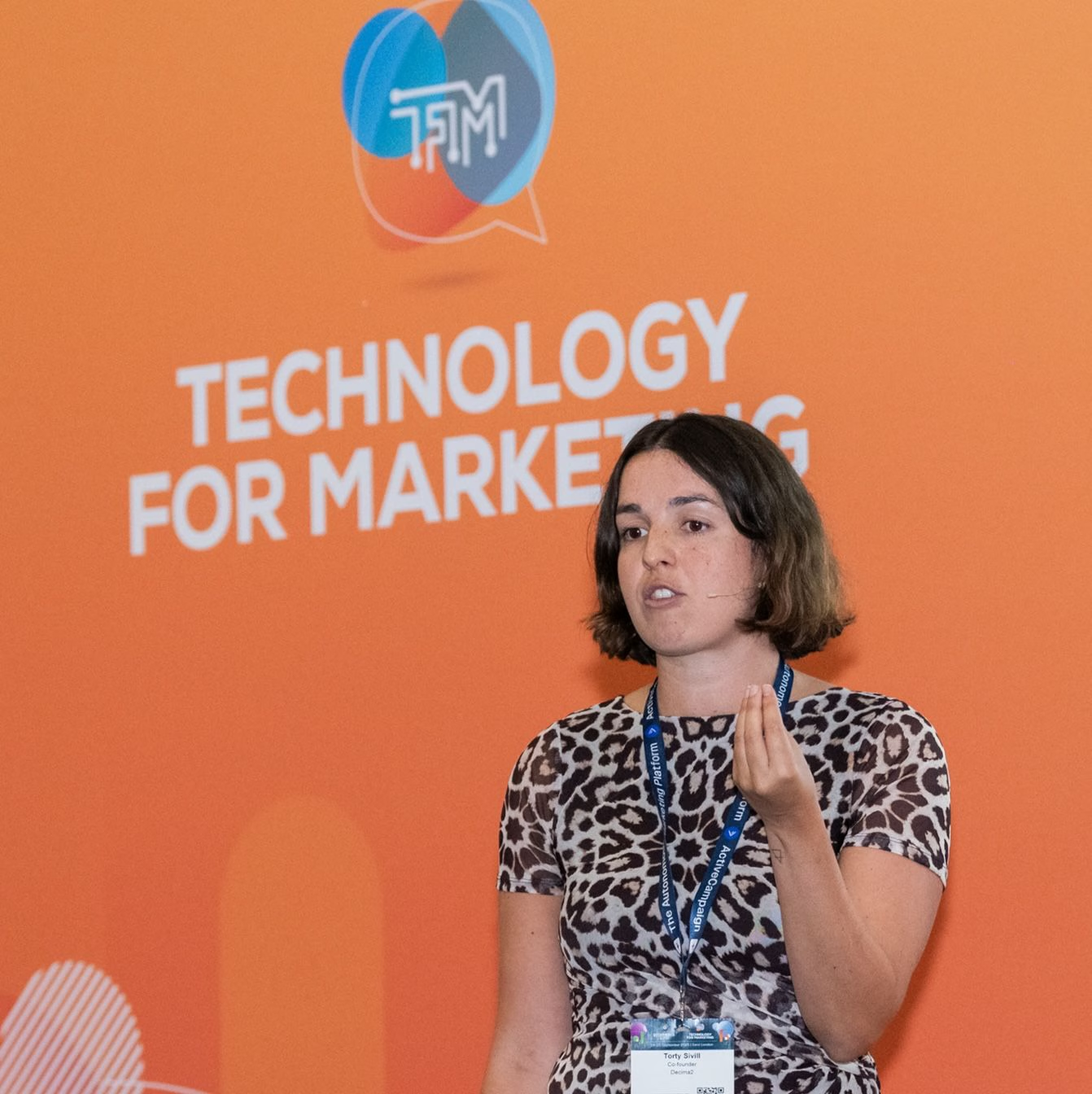
Decima wins Technology for Marketing Award

Decima named the Most Exciting Emerging Business using AI for Marketing at the Technology for Marketing event in London, recognising leadership in trustworthy and explainable AI.

October 9, 2025
Tech for Marketing Award

Recognition for Trustworthy and Explainable AI in Marketing

We’re proud to announce that Decima has been named the Most Exciting Emerging Business Using AI for Marketing at this year’s Technology for Marketing event, held at the ExCeL Centre in London.

The competition brought together leading innovators from across the UK, with finalists pitching live to an audience of over 100 industry professionals and a judging panel featuring representatives from Microsoft, NibbleAI, and CloserStill Media.

Why Explainability Matters

The award highlights a growing recognition that while interest in AI for marketing continues to accelerate, trust remains the defining factor for adoption.

At Decima, we’re building AI that marketers can not only use—but understand. Our focus on causal, explainable AI enables businesses to see why campaigns perform, not just how well they perform. As one judge put it, “You had me at explainable AI.”

A Step Forward for Trustworthy Automation

This recognition underscores a shift in how marketing teams evaluate AI tools: transparency and accountability are becoming as important as performance.

Winning this award is validation that our mission – to make automated marketing as trustworthy as it is effective – resonates across the industry.

What’s Next

This milestone reinforces our commitment to advancing explainable AI for growth decision-making. We’re continuing to expand the Decima platform to help teams experiment, measure, and optimise with confidence.

Back to insights

Decima Named Tech Nation Emerging Star 2025

We were thrilled to be named one of Tech Nation’s Emerging Stars for 2025 – a recognition that validates our innovation in causal AI for growth intelligence.

July 5, 2025
Casual Ai

What Tech Nation’s Emerging Stars Represents

Tech Nation’s Emerging Stars program identifies and supports the UK’s most promising early-stage tech companies. This highly competitive initiative provides funding, mentorship, and access to the UK’s most influential tech networks. For startups building the future of technology, it’s recognition that your innovation has genuine market potential.

The Problem We’re Solving

At Decima, we built an AI-driven platform that helps companies understand what’s actually driving growth, not just what appears to be working.

The challenge we tackle: businesses miss growth targets because they either aren’t investing enough in the right activities, or they are investing but can’t tell what’s working. When teams rely on attribution tools or spreadsheets that struggle with complexity, the result is missed revenue, wasted effort, and decisions based on intuition.

Our causal AI engine connects to marketing performance data and identifies what has genuinely moved the needle, quantifies impact across different channels and content, and uncovers the hidden levers that drive growth – even when results are noisy or overlapping. Unlike traditional attribution or A/B tests, we don’t require perfect experiments or clean data. We use causal models to isolate true impact.

This delivers 80% of the value of a dedicated growth analyst without the overhead.

Why This Recognition Matters

Being named a Tech Nation Emerging Star validates our mission to transform how businesses understand and optimize their growth. The program connects us with mentors and networks who understand both the technical complexity of causal AI and the commercial realities of scaling technology companies.

The £335k investment accelerates our ability to prove our thesis with more customers. We’ve already seen clients achieve 40%+ CAC reductions and 14%+ growth uplifts within months of using our platform.

London Tech Week and Beyond

The opportunity to present at London Tech Week puts Decima in front of the UK’s most influential tech leaders and investors. It’s a platform to showcase how causal AI can solve one of the most persistent challenges in business: understanding what actually drives results.

Tech Nation’s Emerging Stars represents something powerful: recognition that the future belongs to companies solving real problems with innovative technology. Our selection validates that helping businesses experiment their way to success with confidence rather than guesswork isn’t just useful – it’s essential.

Back to insights

Breaking Barriers: Decima wins WomenTechEU, advancing the future of Causal AI

We’re honoured to win the WomenTechEU award – recognising not just our technology, but our mission to make causal AI accessible and inclusive.

January 5, 2025
Women Tech EU Logo

What WomenTechEU Represents

WomenTechEU is far more than a funding initiative. It’s an EU-funded movement creating a more gender-balanced entrepreneurship ecosystem across Europe, addressing one of the most persistent challenges in deep tech: the underrepresentation of women founders. Their mission resonates deeply with our values – providing women in deep tech with the opportunities, resources, and support they need to not just participate, but to thrive and lead.

The Causal AI Revolution We’re Building

At Decima, we exist to make decision-making measurable. We’re not just building another analytics platform – we’re creating an AI-driven engine that helps pre-product-market-fit companies understand what’s actually driving growth, not just what appears to be working.

We solve a fundamental problem: you’re missing growth targets because you either aren’t investing enough in the right activities, or you are investing but have no idea what’s working. When most teams rely on attribution tools or spreadsheets that can’t handle complexity, the result is missed revenue, wasted effort and decisions based on gut feeling.

Our causal AI platform connects to your marketing performance data and identifies what has actually worked, quantifies the impact of different content and channels, and finds the hidden levers that drive growth – even when results are noisy or overlapping. Unlike attribution or A/B tests, we don’t need experiments or clean channel data. We use causal models to isolate what moved the needle and why.

This gives you 80% of the value of a growth analyst or data team without hiring anyone. You can experiment your way to product-market fit with confidence, scaling only what truly drives results rather than what merely correlates with them.

Building Tomorrow’s Innovation Ecosystem

The WomenTechEU community represents something powerful: a recognition that innovation thrives when we expand who gets to innovate. Supporting women founders isn’t charity – it’s strategic investment in a more dynamic, creative, and resilient technology sector.

Here’s to breaking barriers, advancing causal AI and proving that when we invest in diverse founders, everyone wins.

Back to insights

Decima wins Oxbridge AI challenge

We’re thrilled that Decima was selected as the winning startup in this prestigious annual pitch competition for early-stage AI companies from Oxford and Cambridge.

December 15, 2024
Oxbridge Ai

What the Oxbridge AI Challenge Represents

The Oxbridge AI Challenge is an annual program that attracts 200+ early-stage AI startups who compete through 3 rigorous rounds, with comprehensive mentorship, resources, and validation from some of the sharpest minds in academia and industry. For AI founders, it’s the gold standard of early validation.

The Problem We’re Solving

At Decima, we exist to make decision-making measurable.

The core problem: you either aren’t investing enough in the right activities, or you are investing but have no idea what’s working. When teams rely on attribution tools or spreadsheets that can’t handle complexity, the result is missed revenue, wasted effort, and decisions based on gut feeling.

Our causal AI platform connects to your marketing data and identifies what has actually worked, quantifies impact across channels, and finds the hidden levers that drive growth. Unlike attribution or A/B tests, we don’t need clean experiments. We use causal models to isolate what moved the needle.

This gives you 80% of the value of a growth analyst without hiring anyone.

Why This Recognition Matters

Winning the Oxbridge AI Challenge validated both our technical approach and market need. It connected us with mentors who understood the complexity of causal inference and the realities of startup growth – a combination that became central to how we’ve built the platform.

More importantly, it gave us the credibility to prove our thesis with real customers. Clients have seen 40%+ CAC reductions and 14%+ growth uplifts within months of using our platform.

Building the Future of Growth Intelligence

The Oxbridge AI Challenge represents something powerful: academic innovation solving real business problems. Our victory there helped establish the foundation for what we’re building today – a platform where experimental growth leaders can navigate early-stage scaling with confidence rather than guesswork.

This year, we’re honored to return as panelists for the competition – helping identify the next generation of AI innovations that will solve real market problems.

Decima is turning cutting-edge causal AI research into technology that helps companies experiment their way to product-market fit. This is how we bridge the gap between academic excellence and market impact.

Never waste marketing spend.

We’ll email you an ad and website page built to resonate with your target customer in 10 minutes.
Try before you buy
Get in touch

Get in touch

Get in touch

What can we do for you?

Tell us where you're spending — we'll show you how much you could save, and what to do next. No obligation.